Tuesday, April 9, 2013

AUTHOR AUTHOR: DANA JOY WYZARD, PART II

Gentle Readers . . . and Maxwell,

To read the synopsis of Treadwell by Dana Joy Wyzard, and the first part of my interview with this "amazing" woman (as Sherry Ellis said, and you'd better not doubt Sherry Ellis), please click HERE.

And now for the rest of the interview with the amazing Dana:


Q. What if Treadwell was made into a movie? Who would you want playing the lead roles?

A. Oh, no!  As if I haven't already laid out the cast!!  Nelda would HAVE to be played by Helen Mirren, or Glenn Close (if Helen refused).  

And there's no one else who would do as Wosie Mae except for Kathy Bates.

And if Lindsay Lohan shows up to play Laura, I'm going to personally shut down the set.

Q. What have you learned from the publication process? What do you wish you'd known before you started?

A. Well, I've honestly learned there is nothing GOOD about the publishing process.  In fact, I'll make this easy with a list:

(1) There's no such thing as a good query letter.  
(2) Agents have assistants, and their only job is to shove your query into the circular file, and not bother the agent.
(3) Assistants are usually college kids looking for the next HUNGER GAMES so their boss will pat them on the head.
(4) Even if you pay a proofreader to check for mistakes, don't take it on faith that they found all of them.
(5) DO NOT proofread your manuscript on your laptop.  You'll get comfortable and start scanning instead of inspecting.
(6) Print it out and proofread the real words off of real paper.  You'll be amazed at how many times you mis-spelled broccoli.
(7) Everyone will look at you as an impostor if you pay to have your book published.  Get used to it.  It was the only way it was going to happen in this economy.

Q. Tell me something about the book that makes you feel really good.

A. My bucket list is now finished.  And if I hadn't gotten that manuscript published, it was going to stay in the back of the drawer, making fun of me for the rest of my life.

Q. This is the question I always asked last during interviews when I was a reporter: What do you most want the world to know about you?

A. Anything but the truth!


Tomorrow, you'll get my review of Treadwell, which you can purchase at http://www.amazon.com/TREADWELL-Sheltered-foothills-Southern-reclusive/dp/1483603644 or http://bookstore.xlibris.com/Products/SKU-0131151003/TREADWELL.aspx. And be sure to visit Dana in her guise as Little Lotta Joy at her blog, WITLESS RELOCATION PROGRAM.

\
Dana made those bullet holes in the cover herself.
I really think you should buy her book.


Infinities of love,

Janie Junebug


Monday, April 8, 2013

AUTHOR AUTHOR: DANA JOY WYZARD

Gentle Readers . . . and Maxwell,

Today I'd like to introduce you to an author whose first book, Treadwell, was published recently. Her name is Dana Joy Wyzard, but you may know her as Little Lotta Joy, who blogs at Witless Relocation Program.


This is the photo of Dana that's on her book.
Doesn't she look nice?
Sometimes she pretends she's not nice, but she really is.

Recently I had the pleasure of interviewing Dana. Because her answers are so interesting and will be so helpful to her fans and to other writers, rather than shorten her responses as she told me to do (I'm extremely disobedient), I'm giving you half the interview today and half tomorrow. But before I amaze and delight you with my questions and her answers, I want to share with you the synopsis of Treadwell:

After living for sixty years in the cabin of her birth, Nelda Pike is as resilient and self-reliant as she needs to be. Like other residents in the backwoods town of Treadwell, she guards her anonymity with a fierce tenacity and a shotgun.

When she discovers a terrified young woman stumbling beside the country road, Nelda goes against her better judgment and offers temporary sanctuary. As the only witness to her mother's brutal murder, seventeen year old Laura is running for her life.

Successfully tracking her to Nelda's secluded cabin, the killers forcibly abduct Laura and disappear into the backwoods.

Enraged, Nelda reaches out to her lifelong friend, Wosie Mae -- a woman as irascible and indomitable as Nelda herself -- for help.

Together, two old women with shotguns, and a geriatric hound, are now on the murderer's trail.

And now here's our author, Dana Joy Wyzard:


Q. What's the very first thing that popped into your head that led to the plot of this book? Was it an incident or a character, or did something happen in your life that led you to this story? 

A. I remember very clearly, sitting on the couch in the tiny living room of my house.  It was the darkest winter I had ever lived through.  An ice storm was covering about two feet of snow and I could hear the sounds of shotgun blasts my trees made as they snapped in two.  Electrical cords were slithering through the house, out to the generator, and I caught myself staring at the wall.

I had been caught in another of my depressions, only this one wasn't going to end soon.  I needed something, anything, to throw my imagination into.

I started typing on my laptop.  The most innocuous sentences began lining up on the screen.  Tedious.  Tired words.  Too common to what I was feeling.  I kept on typing for 98,000 words.

I knew there was something missing in my manuscript.  I realized I was merely typing the feelings that were living in my brain at the time. Innocuous. Tedious.  Tired.

I needed a woman who could fight back.  I needed a woman who valued her own life and opinion.  One who would face danger instead of looking away.  I needed a woman who would not trip and sprain her ankle, or look for help from anyone but herself.  I needed a hero, and her name was suddenly Nelda Pike.

Q. What's your writing process like? How did you stay organized? A lot is going on in this book. Did you plan the entire plot in advance or did the characters control the action? If you planned it in advance, how did the finished product compare to your original plan?

A. Organization is not a word I'm familiar with. Intellectually, I know I'm supposed to make notes, outlines, use time frames and have SOME idea where my book is going.  All I knew was that I was in love with Nelda and felt a giant responsibility to her.

I write in the linear fashion.  Straight forward from point A to point B.  I only used a flashback once in the entire writing process.  It was necessary to the integrity of one of my characters who suddenly popped up on one of my pages.

I loved tossing out that first manuscript and starting over in such a way that my own story line kept me on the edge of my seat. I NEVER knew what was coming next.

Q. As an avid reader of your blog, I see you, or at least bits and pieces of you in more than one character. I think Nelda is you; Wosie is you; even Chlotilde has a bit of you in her (I suspect); and Debra may be you. Am I right? How much of the book is based on reality and how much came from your imagination? I suspect Martha is based on your mom.

A. Nelda is the me that would have saved me from all the horrors that happened in my life.  Wosie Mae is the me that runs to the aid of others and will put up a stronger fight for a friend than I could justify giving to myself.

In both of them, you will find no apologies for their strengths, and no self-doubt at any time.  Those are definitely qualities that I have always yearned for.

Just to prove how well an author can hide her inner feelings from herself, it wasn't until you suggested that "even Chlotilde has a bit of you in her" that I went into shock.  At first I huffed up and wondered where the hell could you have gotten THAT idea.  After I smoothed my feathers, I realized that she was the weak link.  The one who had to lose her mind in order to find her strength.  

Martha AND Claude represent the vileness and pure evil that owes its power to the weaker ones in their midst, leading to a complete breakdown of how others view themselves instead of the perpetrators.

Thank you, Jane. Now I need a therapist.

Since we have Dana in need of immediate therapy, we'll stop for today, and finish the interview tomorrow. Doesn't she give interesting answers? (Nod your heads or go ahead and say out loud, Oh, yes.)

Before I send you my love, though, we need to talk business. Authors need readers. Authors need sales. Authors need reviews. If you've already purchased and read Treadwell, then please promote it and review it on Amazon and on your blogs. 

If you don't have Treadwell, and maybe you don't know it yet but I know you want it, then it's time to treat yourself to a great book. I have finished reading Treadwell. I love it, and I'm going to give it a glowing review on Wednesday. I purchased my copy from Amazon. It's available at http://www.amazon.com/TREADWELL-Sheltered-foothills-Southern-reclusive/dp/1483603644. It's also available from Xlibris at http://bookstore.xlibris.com/Products/SKU-0131151003/TREADWELL.aspx.


Infinities of love,

Janie Junebug

Friday, April 5, 2013

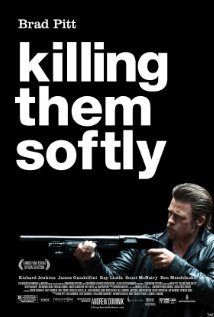
MOVIE WEEKEND: KILLING THEM SOFTLY

Gentle Readers . . . and Maxwell,

Today I present for your consideration a movie now available on DVD, Killing Them Softly (2012, Rated R).


I can tell you right now: This movie is not for everyone. I'm not just giving you my usual warning about not letting your kids watch. If violence bothers you, no matter how stylishly it's executed, then you don't want to watch Killing Them Softly.

Some idiot low-lifes rob a Mob-run card game, wreaking havoc with local criminal activity. So Jackie Cogan (Brad Pitt) is hired to "remove" certain people from action and restore the economy.


Jackie Cogan: You ever kill anyone?
Driver: No.
Jackie Cogan: It can get touchy-feely.
Driver: Touchy-feely?
Jackie Cogan: Emotional, not fun, a lot of fuss. They cry. They plead. They beg. They piss themselves. They call for their mothers. It gets embarrassing.
Jackie Cogan: I like to kill them softly, from a distance. Not close enough for feelings. Don't like feelings. Don't want to think about them.

This is not your mother's movie about criminals. We don't see the action from the point of view of a good detective or a corrupt police officer or the Mafia don. We're in the down and dirty with the criminals themselves, one of whom complains he has to stick to crime to make a living because even when he can get a legitimate job, he doesn't have any way to get there. 

Now don't start writing comments to me about how I'm a soft-on-crime liberal. I didn't write this movie, and even though it indicates that some criminals are trapped in their line of business, this movie doesn't feel sorry for them either. Their lives suck. Their deaths suck. When a bullet goes through the window of a car and the glass flies into the air in slow motion so that it almost looks pretty, there's still someone on the other side of that window who is a bloody stinking mess. 

Throughout the movie we see news clips about the economy tanking, and finally, President Obama talking about how we are a nation of one people. Jackie Cogan doesn't see it that way:

Barack Obama (on TV): ...to reclaim the American dream and reaffirm that fundamental truth, that, out of many, we are one...
Driver: You hear that line? Line's for you.
Jackie Cogan: Don't make me laugh. One people. It's a myth created by Thomas Jefferson.
Driver: Oh, so now you're going to have a go at Jefferson, huh?
Jackie Cogan: My friend, Thomas Jefferson is an American saint because he wrote the words 'All men are created equal', words he clearly didn't believe since he allowed his own children to live in slavery. He's a rich white snob who's sick of paying taxes to the Brits. So, yeah, he writes some lovely words and aroused the rabble and they went and died for those words while he sat back and drank his wine and fucked his slave girl. This guy wants to tell me we're living in a community? Don't make me laugh. I'm living in America, and in America you're on your own. America's not a country. It's just a business. Now fuckin' pay me.

We live in a capitalist society, and criminals are part of the business world. That's what I take away from Killing Them Softly.

If you decide you want to watch this movie in spite of the violence, you might feel dissatisfied with the end. The good guys don't ride in on their white horses and take out the bad guys. There is no Lone Ranger, no Superman, no Batman -- just ugly life. And because this movie achieves (what I believe to be) its purpose, it's well made, and Brad Pitt's performance is excellent.

Killing Them Softly has The Janie Junebug Seal of Approval.

Infinities of love,

Janie Junebug

Thursday, April 4, 2013

BLOGFEST

Gentle Readers . . . and Maxwell,

Elisa at The Crazy Life of a Writing Mom has come up with a Random Acts of Kindness Blogfest. I think it's a great idea. Click on the title of her blog for more information and spread the word with this Random Acts of Kindness button:


 photo raoc_zps0fb7dd8c.jpg

Wednesday, April 3, 2013

BOOK NOOK: JENNIFER WORTH

Gentle Readers . . . and Maxwell,

Last fall I discovered a great new TV series on PBS that came to us from the BBC: Call The Midwife (read my review of the show HERE).


I noticed that the series was based on a book with the same title by Jennifer Worth, so I gave myself a Christmas present and bought three of her books. One was available on Amazon, but all three could be purchased from The Book Depository in England -- more convenient to buy them all at the same time, and they offer free shipping, even to us louts across the pond.

I've read all three memoirs now and hereby pronounce myself a Jennifer Worth fan.

The first book is Call The Midwife. Young nurse/midwife Jenny lands at a convent in London's East End during the 1950s, where she works with the nuns who have offered midwifery services for many years to the women of the East End at no cost. Three other young nurses who are not nuns also are posted there. Worth tells one story after another about the babies she delivers, the families she meets, and the nuns themselves, and how she came to admire their hard work.

Most women in England had their babies at home during this time and were terrified of going to a hospital (hospitals were thought to be unsafe by the general populace and many were former workhouses; the specter of the workhouse still had the power to terrorize people). So Jenny and her colleagues travel from one house to another. One place might be a fairly comfortable dwelling, while the next might house 10 or 12 family members in three small rooms.

I was quite shocked to learn that people were still living in World War II bombsites during the '50s. Even though the places had been condemned years before, England's critical housing shortage remained and forced many to take lodgings wherever they could get them.

The descriptions of the births are interesting, too. Medical personnel believed at the time that women should lie on their left sides while giving birth. Enemas were always administered to the mother. And I finally learned what the "lying in" period means. I've seen this term many times and always wondered about it. It meant that the pregnant woman was tucked into bed as the time to give birth approached, and then stayed in bed after the birth, resting and bonding with her newborn. Relatives and neighbors brought meals and took care of older children. For a woman who might have a dozen children or more, this lying in was the only rest she ever got.

The second book, Shadows of the Workhouse, is quite different from Call The Midwife. Rather than taking us from one new mother to the next, Worth divides the book into three sections.

"Workhouse Children" provides a history of the workhouses, which were as bad as Dickens made them out to be in his fiction, and focuses on three adults who had grown up in the workhouse. Their stories are sad, and amazing. I'm surprised that anyone survived the workhouse. "The Trial of Sister Monica Joan" is about an elderly nun accused of shoplifting. The translation of Cockney slang provided during the trial is a hoot. In "The Old Soldier," young nurse Jenny forms a relationship with elderly Joseph Collett, who needs care for ulcers on his legs. As Jenny takes care of Joe, they become close friends. Joe Collett's story is also a sad one.

The third book, Farewell to the East End, has more stories about families and birth, but also provides a lot of information about tuberculosis, a scourge that most of us today don't understand. In the not-so-distant past, however, TB could decimate an entire family. In an especially interesting recollection in the book, Chummy -- a young nurse/midwife -- tucks her skirt into her bloomers and climbs a rope ladder to reach a woman in need on a ship. Worth also describes how the East End ended. The slums were razed; people were transported to new housing, whether they wanted to go or not; and the nuns were no longer needed there.

These memoirs are not for the squeamish (Maggie), but I found them fascinating because of the medical information and because of the stories of how people lived in England not so very long before I was born. Many of Worth's recollections are sad, but just as many are filled with joy and humor. Her style is simple, clean, and focused -- a style I seek in my stories about the nursing home.

All three of these books earn The Janie Junebug Seal of Approval.

Infinities of love,

Janie Junebug


Tuesday, April 2, 2013

THE TIME I ALMOST MET TONY MENDEZ

Gentle Readers . . . and Maxwell,

When I was a newspaper reporter, I interviewed a lot of interesting people: the woman who had been taken from her Ukrainian village and forced into slavery by the Nazis; the woman whose childhood recovery from leukemia was deemed the third miracle that led to the sainthood of Elizabeth Ann Seton; the dog owners whose Bouvier de Flandres won more competitions than any other dog in a single year; and actor Benicio del Toro, not long before he won an Academy Award for Traffic.

Oh, boy, I wish the interview with del Toro
had been in person and not on the telephone.
Shhhh! Don't tell Elvis Aaron Schwarz.

But because of circumstances, I missed out on a couple of interviews I really wanted to do.

For example, I had a "date" with my favorite historian, Doris Kearns Goodwin, that I didn't get to keep.

And now that I've seen Argo, I'm really kicking myself over the time I almost met retired CIA operative Tony Mendez (played by Ben Affleck in the movie, which I reviewed HERE). Tony Mendez retired from the CIA quite some time ago and married another former CIA agent. The two of them, along with Tony's son, have become artists, with a studio in rural Washington County, Maryland. The county where I lived.  The county where I was a reporter. 

The Mendez family very graciously invited children from an elementary school to visit their art studio. In the county where I lived. In the county where I was a reporter.

Guess who got the assignment to cover the story?

Although I didn't know at the time that Tony Mendez had been such a big deal in the CIA, I knew he was a former agent who had written a book about his work called The Master of Disguise.

Washington County is kind of a sprawling area. I lived in the valley of the Catoctin Mountains, but the county included mountainous regions and out-of-the way spots that could be difficult to find, even on a map. No wonder Camp David is in the Catoctin Mountains. It wouldn't be easy to find. Many locals know where Camp David is, but wouldn't reveal the location to save their lives.

Before I was to go to the Mendez's studio, I studied my map. The studio had to be in a place close enough to the elementary school so that the kids could get there. I looked and looked, and absolutely nothing seemed familiar. I had never been to that part of the county.

In the end, I missed the visit to the art studio. I just plain couldn't find it.

So that's the time I almost met Tony Mendez, who helped rescue six Americans from Iran during the hostage crisis and was involved in many other high-end hush hush operations. I guess he was still so good at hiding that I couldn't succeed in my part of the hide-and-seek game.

I told my boss I was sick, and that's why I didn't get the story. Shame on me for lying, but now that I've seen the movie, I feel as if I've really been punished because I didn't get to meet Mendez.

Oh, why hadn't the GPS been invented yet?

Infinities of love,

Janie Junebug

Monday, April 1, 2013

HAZEL'S BLACK BOYFRIEND

When I was still a mere Hospitality Aide at the nursing home, one of my tasks was to assist residents in getting to the dining room for meals. I'd push a wheelchair or stroll next to someone who was a little unsteady on her feet.

Hazel walked quite well, but she felt more comfortable about ambling to dinner with her arm through that of an aide's.

At first, she accepted my offer to walk with her, but then suddenly, she began turning me down. "What's wrong, Hazel?" I'd ask.

A slight blush reddened her pale cheeks, and looking at the floor she mumbled, "Nothing's wrong. I want to walk to the dining room with my black boyfriend."

"Uh, okay," I said. I could see she had quite a crush on someone, but who could it be? We didn't have any black men working in the nursing home. I thought that perhaps one of the black ladies on her hall had a brother or son who came to visit, and Hazel was enamored with him.

I didn't see who walked into the dining room with Hazel that night, but from then one, every time I offered to walk her to dinner, she gave me the same answer about waiting for her black boyfriend to take her. I asked some of the other aides, "What's going on with Hazel? She won't let me walk her to the dining room."

They said they had gotten the same response from her, and we pondered who her black boyfriend could be.

Finally, one evening I saw her enter for her meal on the arm of my friend Lynn, also a Hospitality Aide and a black lady. I looked at them with surprise, and noticed the glow that lit up Hazel's face. She looked so pleased and proud.

When I had a moment alone with Lynn after dinner, I told her that Hazel had been refusing to walk with me because she wanted to be with her black boyfriend.

Lynn and I locked eyes. Then we started to laugh. "I'm Hazel's black boyfriend?" she sputtered. "I know my hair is short and I'm not very shapely, but no one has ever mistaken me for a man before."

"Well, Hazel's sight isn't that great," I reminded her. "She's confused about a lot of things. Remember the day she thought we were doctors?"

Lynn and I spoke with the other aides. Although we couldn't help laughing at Hazel's mistake, we weren't making fun of Hazel. We just had to tease Lynn a bit.

But then we all started to wonder if we should tell Hazel the truth about Lynn. I remembered how happy Hazel looked when she walked into the dining room with Lynn and made the decision for the group. "No. We can't tell her. We'd be stealing her happiness. She's completely on her own. She's never had a visitor. Hazel deserves this little bit of joy."

Although Lynn wasn't thrilled about being "the man" in Hazel's life, she agreed that it was a harmless charade.

From then on, when Lynn was on duty, she and Hazel always entered the dining room arm-in-arm, with Hazel's eyes sparkling. No one ever told Hazel that Lynn was a woman.

And when Hazel died, her "black boyfriend" was at her side, holding her hand.